
Sign up to view this video
Join Now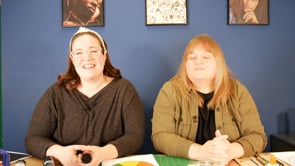
Color Theory and Color Mixing
About This Video
In this art enrichment video, Kate and Nicole introduce participants to basic color theory and color mixing.
The video begins with a six-color color wheel. Participants learn about primary colors, including red, blue, and yellow, and secondary colors, including purple, green, and orange. Kate and Nicole explain how secondary colors are made by mixing two primary colors together, such as red and yellow to make orange, blue and yellow to make green, and blue and red to make purple.
The video then moves into painting and color mixing. Kate and Nicole show several kinds of paint, including watercolor, acrylic, and gouache, and explain that different paints have different qualities. They demonstrate how to mix colors on a palette or directly on paper, how to experiment with different amounts of each color, and how to use white and black to make tints and shades.
The video also introduces color relationships. Participants learn that colors near each other on the color wheel can feel harmonious, soft, warm, or calming, while complementary or contrasting colors can make parts of a picture stand out. This video gives participants a practical art activity focused on color, paint mixing, planning, experimentation, observation, and creative choice.
Supplies Needed
Paint, such as watercolor, acrylic, or gouache
Primary paint colors: red, blue, and yellow
White and black paint, optional for tints and shades
Paint brushes
Water cup
Paper towel
Palette, paper plate, newspaper, magazine page, or another safe surface for mixing paint
Paper or worksheet
Apron, smock, or old shirt if using acrylic paint
Table covering, such as craft paper or butcher paper
Good For
Adults with IDD who enjoy art, painting, color mixing, experimenting with materials, or learning how colors work together.
Caregivers looking for an art enrichment video that introduces color theory through clear examples, painting, and hands-on exploration.
Adult day programs, home routines, or group activities about art, color, painting, creativity, planning, observation, and self-expression.
Participants who benefit from visual modeling, conversation, repeated examples, choice-making, and permission to experiment without needing a perfect result.
How to Use This Video
Use this video as an art enrichment activity for a home routine, day program, small group, or creative session.
Caregivers can help participants gather paint, brushes, water, paper towels, paper, and a safe mixing surface. If using acrylic paint, caregivers may want to provide an apron, smock, old shirt, and table covering because acrylic paint may not wash out of clothes easily.
Participants can follow along by mixing primary colors to make secondary colors, testing different amounts of each color, adding white to make lighter tints, adding black to make darker shades, or creating swatches before making a picture.
This video can also be used as a planning activity before an art project. Caregivers can pause the video to talk about warm colors, cool colors, harmonious colors, complementary colors, favorite color combinations, or which colors participants want to use in their own artwork.
Because this activity involves paint, water, brushes, mixing surfaces, and possible mess, caregivers should provide support with setup, cleanup, clothing protection, safe materials, pacing, and any needed hand-over-hand or visual support.
At the end, participants can name a color they mixed, describe a color combination they liked, or use what they learned to start a painting of their own.